
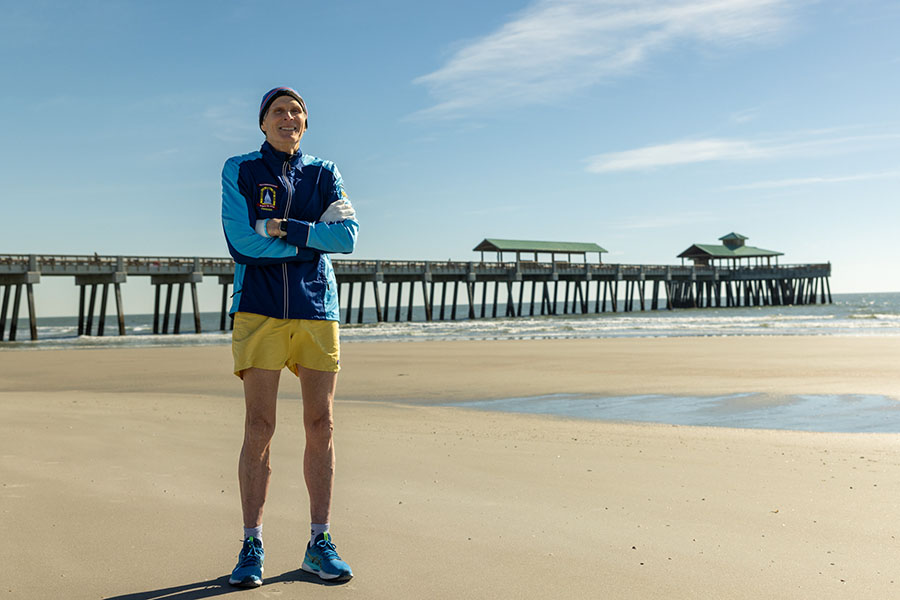
Gratitude for the team that kept him running
On Jan. 5, 2024, as the pre-dawn darkness still blanketed Charleston, Nelson Ohl woke at 4 a.m., his mind a tangle of nerves. The thought crossed his mind – how many people back out of surgery at the last minute, paralyzed by fear? He had spent months preparing for this moment, ever since his primary care doctor Laura Lee Kinney first heard his heart murmur in August and urged him to see a cardiologist. Now, there was no turning back.
At 7:15 a.m., they wheeled him into the operating room at Roper Hospital. The room was stark white, sterile and bustling with activity. “There were ten to fifteen people in the room,” he later wrote in his journal. “I remember looking around a little, and then that was it. I was out.”
When he woke, the reality of his seven-hour valve replacement surgery set in. “I felt starved for breath,” he recalled. His body was a battlefield of wires, tubes and incisions. The exhaustion was unlike anything he had ever known. And yet, even through the haze, a new thought settled in: he had been given a second chance.

Nelson was no stranger to pushing his limits. For eight years, he had maintained a running streak, logging at least one mile every single day. It wasn’t just about fitness; it was discipline, mental clarity. Running had been a ritual that shaped his life. His last run before surgery had been on New Year’s Eve 2023. He had wanted to complete the full eight years before pausing, before putting his trust in cardiothoracic surgeon Dr. Scott Ross and the team at Roper St. Francis Healthcare to replace his failing aortic valve.
Recovery was humbling. The man who had once run miles with ease now struggled to walk to the cul-de-sac. His first steps were slow, guided by his trekking poles. His wife, Mary, walked beside him, steady and patient. His neighbor rode along on a bike when he graduated to cycling. Every movement, every breath, was a reminder of both the fragility and resilience of the human body.
He faced a few setbacks, but he never let them define his journey. Instead, he focused on what lay ahead. By late February 2024, he felt strong enough to start running again.
On Feb. 28, 2024, Nelson laced up his running shoes and stepped outside. The first run was short, tentative, but it marked the beginning of something bigger – his second streak. “I knew it would help me rehabilitate my heart,” he said. “Watching my resting heart rate drop after surgery was like seeing my body repair itself in real-time.”
With each day, the miles added up. Running used to be a habit. Now, it’s a celebration. The fear that had loomed the weeks before surgery had been replaced with something else: gratitude. “At any other time in history, they would have just rolled me over and thrown me in a ditch,” he said with a laugh. “Now, I’ve basically got an extended warranty on my life.”
He thought often of the team that had given him this chance – Dr. Ross, the nurses, the technicians. “I sent them an email after I did a ten-mile run,” he said. “Just to say thank you. Every single person I met in that hospital was an expert. I had total confidence in them.”
A little over a year after surgery, Nelson reached 365 consecutive days of running—earning his spot once again on the U.S. Running Streak Association list. “I think about my heart every day,” he admitted. “Not in fear, but in gratitude. January 5 feels like an alternate birthday for me.”


Beef or bacon? The unexpected menu of heart valves

When Nelson Ohl faced heart valve replacement surgery, Dr. Ross presented him with an unusual choice: cow or pig? It sounded less like a life-saving medical decision and more like a dinner menu.
Biological heart valves, like the one Nelson received, are made from the pericardial tissue of cows or pigs. Unlike mechanical valves, which require lifelong blood thinners (and don’t come with a farm animal backstory), these tissue valves function more naturally within the body.
For Nelson, the decision was surprisingly sentimental. His late mother had a lifelong love of cows, collecting figurines and decorations of them. “There was so much karma for a cow,” he said. And while he left the final call to his surgeon, he made it clear – if he had to have a little livestock in him, he’d prefer a cow.
“I thought they just took the valve right out of the animal’s heart,” he admitted. In reality, the valves are carefully engineered from pericardial tissue (a sac around the animal’s heart), shaped and processed to function just like a human valve.