
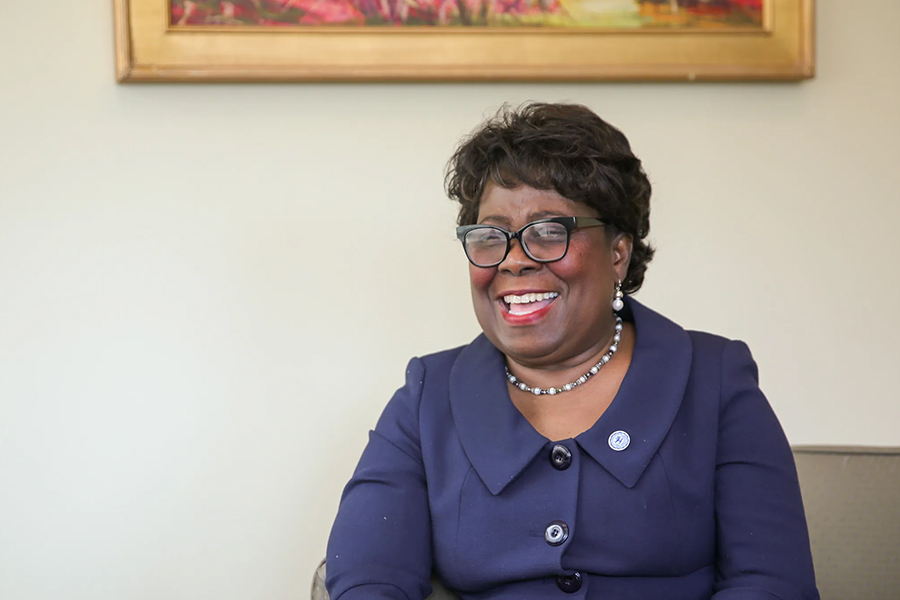
Roberta Huger-Pinckney was the first African American woman to serve on the Roper St. Francis Healthcare Board of Trustees. Throughout her career, she worked as the hematology laboratory supervisor at St. Francis Xavier Hospital, worked for the Franklin C. Fetter Family Health Center and served as CEO of the community-based nonprofit St. James Santee Family Health Center, Inc.
We asked her what Black History Month means to her, how her experience shaped her leadership and what her hopes are for future generations.
1. Tell us what Black History Month means to you.
As many will say in our community, every day is Black History Day. We are very appreciative that there is time set aside for all to acknowledge and honor the Black community, culture and its people.
I believe it’s especially important for all young people in today’s climate to learn and share about Black history.

2. How did your experience growing up during segregation shape your childhood?
I was born and reared in Mount Pleasant. Most of my family is here.
I attended segregated schools here in Mount Pleasant. I attended the old Seven-Mile School, Jennie Moore Elementary School and Laing High School.
I was part of that era that received hand-me-down books. The books we read didn’t feature much about African American history and their contributions to society. We were all indoctrinated to believe that we didn’t have any major contributions to this society outside of slavery.
It wasn’t until the Civil Rights Movement that I began to see African Americans highlighted for their contributions as engineers, inventors, mathematicians and many more.
But ultimately, it was growing up in poverty that motivated me to seek a better life. I was the oldest of 13 children, three of which died as babies. My parents raised 10 children to adulthood. I remember cutting the heel off a pair of high-heel shoes to have shoes to wear to school. I would have to ask my classmates to share their books with me because we couldn’t afford books.
I didn’t want to spend my life in poverty, so I vowed to be a good student. I knew that getting a good education or enlisting in the military were my best options.
3. What drew you to healthcare?
We were assigned to write a paper in my high school home economics class about what we wanted to do when we graduated. My friend wanted to write about being a nurse. Then, she changed her mind and wanted to write about being a medical technologist. So, I changed my mind as well.
I did all the research and wrote the paper. That’s how I first became interested in the medical field.
When it came time to apply to colleges, I applied to three different schools. I was accepted to a Historically Black College (HBCU), Barber-Scotia College in Concord, N.C.
My parents couldn’t afford to send me to college, so I worked my way through college.
The tuition was $500 per semester, and I received a $250 student loan. I stayed with my uncle and his family in New York to work to be able to pay my tuition.
I was a first-generation college student. I received my bachelor’s degree in biology and then attended a one-year post-graduate program at Emory University School of Medical Technology in Atlanta. I was the only Black student in the class, and I believe I was the first African American to be accepted into the program.
I struggled with my first laboratory rotation, which set me back one month behind my classmates. When it came time for my classmates to graduate, the most popular department – microbiology – didn’t have any job openings.
But God works in mysterious ways. When I completed my training a month later, there was a job opening. I began my laboratory career in microbiology.
Shortly thereafter, I took my national board exam and passed. I became a Registered Medical Technologist by the American Society of Clinical Pathologists (ASCP).
After one year working at Emory University Laboratory, I left to begin working for a nonprofit community health center whose mission was to provide affordable healthcare for the underserved and uninsured.

4. Tell us about the challenges you faced as an African American woman working in leadership roles?
I moved back home in 1976 to take a supervisory position in hematology at St. Francis Xavier Hospital (now Bon Secours St. Francis Hospital).
The pathologist that hired me was very impressed with my credentials and experience. Once I was on the job, that’s when I felt I was not fully accepted or respected by my peers and employees. Some of the technologists didn’t appreciate me being their supervisor. They would try to circumvent me by going to the pathologist.
Though, I have to say I had a supportive group that also helped me along the way. Some pathologists would often encourage me to continue the good work I was doing in the face of adversity.
I held this position for ten years and the hematology laboratory department never failed a College of American Pathologists (CAP) or Joint Commission inspection. Because of the CAP and Joint Commission inspections at St. Francis Xavier Hospital, I was also given the opportunity to become a CAP surveyor alongside our pathologists.
Outside of work, I always found support in my family and friends.
As an African American, you’re taught from an early age that you must do twice or sometimes three times as much as your white counterparts to secure and retain a job. It’s always a double standard for workers.
There were times when I had to really go to bat for myself and my salary. In retrospect, my ten years as a hematologist supervisor made me a better person. It led me to become the first female CEO of St. James Santee Family Health Center, Inc.
5. How important is community to you? Where do you find community?
I married a man that was very involved in the community. He was the president of the NAACP’s East Cooper Branch. That’s when I started getting involved in all aspects of social justice, civil rights and activism. I gained the experience through him, and I learned a lot, so I give him praise for that.
Although wanting to work in community health was not my goal, I found meaning in the work that I did once I got there. By working in community health centers and serving the underserved, I embraced it as a calling. We served the “least of these,” the underserved and the uninsured. The people couldn’t afford to get the healthcare they needed. My job was to ensure that the health centers had adequate resources to provide the healthcare they needed.
Even now, in my role as a board member for Roper St. Francis Healthcare, I see opportunities to advocate for and represent my community.
6. Why do you believe it’s important for young people to see diverse representation in leadership?
At the grand opening of Roper St. Francis Berkeley Hospital, a young Black woman came up to me and said, “I didn’t know you were on the board,” meaning she didn’t know there were any African Americans on the board. She told me, “One day I want to be like you.”
That meant so much to me to be an inspiration for this young African American woman.
That’s what I mean when I say it’s important to see people who look like you in leadership. It’s not that we carry the entire race on our shoulders, but it is our duty as African American leaders to be a positive influence for our younger generations, showing them that they too belong in these spaces.
7. As a Roper St. Francis Healthcare board member, how do you help advance diversity, inclusion and health equity initiatives?
When I joined the board, I asked myself, “How can I use this position to help my community?”
I’m able to bring my perspective as an African American and as a woman to the table. I wanted to make a difference.
I quickly realized that diversity, inclusion and health equity were lacking in the Roper St. Francis Healthcare system. So, I partnered with another African American board member to begin championing the board’s need to dive deeper into D&I work. At that time, there were no African Americans in senior management. Later, the board voted to add the office of diversity, inclusion and health equity. We then hired our first Vice President of that department.
I was very proud of the board’s commitment to D&I work in our healthcare system, under the leadership of Dr. Brian Cuddy, our board chair at the time.
Seeing more diverse leadership is just as important as seeing more diversity in education, medicine and more. We must find ways to create pipelines for young people to get into these careers. Businesses must be intentional when it comes to the work of D&I.
In healthcare, our leadership, physicians, middle management and clinical staff all must represent the greater population of the community.
8. The theme for Black History Month this year is African Americans and the arts. How does art fit into your life?
I love music. My mother was a musician and a singer, and she played for several churches as an organist and pianist. Everyone knew Ms. Lydia.
After she passed, there was a transference of her singing gift to me. I now sing in my church choir. Sometimes I sing the same songs she used to sing and that people loved to hear her sing. I can hear her voice when I sing those songs. I love all music genres if it has a beat and is soulful. Gospel is my favorite.
9. Is there anything we didn’t ask that you’d like to share?
When I look back on my life, I thank God for his grace, mercy and favor. I give him all the honor and praise for being my Lord and savior. I learned through the years that I need to lean and depend on Him.
If it wasn’t for the love of Jesus, I wouldn’t have gotten to where I am today.
I am married to Reverend Arthur Pinckney, and we have a beautiful, blended family of six children, 12 grandchildren and four great-grandchildren.