
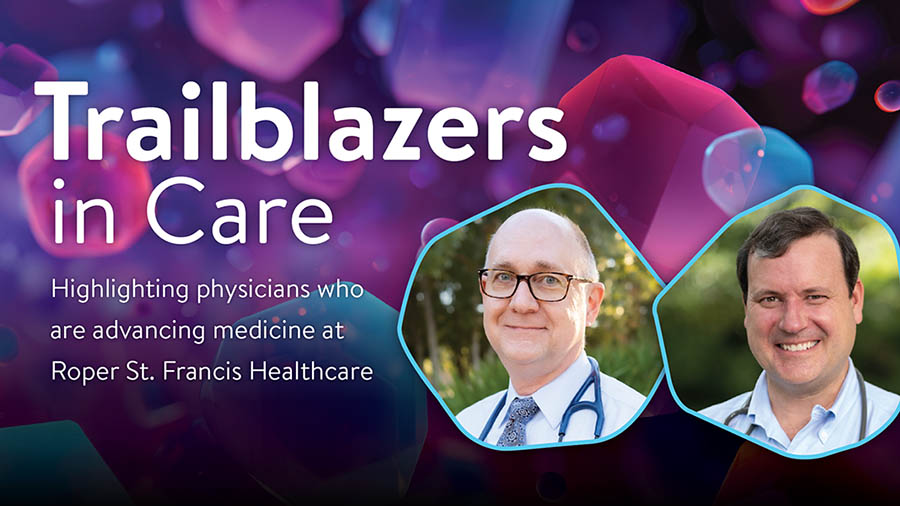
Roper St. Francis Healthcare is proud to introduce CAR T-cell therapy, a groundbreaking advancement in cancer treatment. To learn more about this therapy and the work that went into making it available, we spoke with Medical Director of Transplantation and Cell Therapy Dr. George Geils Jr., who has championed the CAR T-cell therapy program for three years, and Medical Director of the Oncology Integrated Practice Network Dr. George Keogh. They work with Charleston Oncology — a department of Bon Secours St. Francis Hospital.
For those unfamiliar, what is CAR T-cell therapy and how does it work?

Dr. Geils: CAR T-cell therapy stands for chimeric antigen receptor T-cell therapy. It’s an advanced form of immunotherapy that re-engineers a patient’s own T-cells to better recognize and attack cancer cells. After the T-cells are modified in the lab, they’re infused back into the patient to fight the disease directly. For patients with certain blood cancers who have exhausted other treatments, this offers new hope.
Why was it so important to bring CAR T-cell therapy to Roper St. Francis Healthcare?
Dr. Keogh: It’s huge. Offering CAR T-cell at Roper St. Francis Healthcare means that our patients don’t have to go outside the health system for cutting-edge cancer care. It’s a big step toward making advanced, precision therapies accessible within our community. It also aligns with our Strategic Plan 2030 by addressing the clinical needs of the future.
What kind of preparation went into making this therapy available?
Dr. Geils: Bringing CAR T-cell therapy to our patients has been a dream of mine for over three years. It’s been a true team effort, and it takes a very competent team. We had to meet rigorous standards across the board for everything from nursing care to laboratory support. We have a phenomenal stem cell processing facility where a lot of work is done behind the scenes. We recruited Dr. Brian Greenwell to our team who also has experience in this area.
Dr. Keogh: The amount of time and effort that Dr. Geils has put into dreaming and envisioning and bringing this program to life, you just can’t put a number to that. It’s a remarkable achievement for him, for our team and for our entire health system.
Who is considered a good candidate for CAR-T therapy?
Dr. Geils: Right now, CAR T-cell therapy is FDA-approved for patients with certain blood cancers like lymphoma, multiple myeloma or leukemia, particularly those whose disease has either relapsed or not responded to standard treatments. These are often individuals who have already been through multiple lines of therapy and, without another option, may only have a very short time to live.
What have you seen so far in terms of outcomes?
Dr. Geils: The early results are very promising. For example, the first patient treated in our system was devoid of any appreciable toxicity whatsoever. He didn’t have fever, he didn’t have neurological toxicity and he has enjoyed a dramatic improvement in his disease burden. Without the treatment, he perhaps only had months to live.
Does that mean the treatment may extend his life expectancy?
Dr. Geils: Well, it may actually cure him. I think the latest estimate is that this treatment may provide long-term, disease-free survival and possibly cure about 40 percent of patients who essentially have no other good option.
As seasoned oncologists, how has it been witnessing this advancement?

Dr. Geils: Oh, it’s been amazing. It’s a great time to be in medical oncology and hematology because we have so many advances across the spectrum, and this is exciting for admittedly a niche use right now. While the approved indications are currently for blood cancers, there is a lot of interest in applying this technology to solid tumors and other cancers that are more typical. Hopefully we’ll have a breakthrough in FDA-approved options so that the application of this immune therapy can only become broader.
Dr. Keogh: It’s an incredible feeling knowing that some of our sickest patients on such a compressed time frame now can have this amazing opportunity for long-term disease control. It’s what we wish we could offer every patient.
Looking ahead, what does CAR T-cell represent for the future of cancer care at Roper St. Francis Healthcare?
Dr. Keogh: This positions our health system for growth in exactly the right direction — offering the highest level of oncology care at the quaternary level. CAR T-cell is one of the most technologically advanced treatments available today, and only a small percentage of centers across the country are able to provide it. To be among that rare group puts us at the true cutting edge of cancer care. CAR T-cell represents not just a new treatment, but the kind of forward-looking innovation that will shape the future of care at Roper St. Francis Healthcare.
What else would you like our medical staff community to know about CAR T-cell therapy?
Dr. Geils: CAR T-cell is not only one of the most advanced therapies available, but reflects the incredible capacity of our system. We at Roper St. Francis Healthcare are able to offer the latest and greatest cancer treatments available to patients today, and we also have an amazing culture of compassionate care, which is a stellar combination. I’d add that this isn’t just about one therapy, but also about building the infrastructure and expertise that will allow us to continue bringing the most advanced treatments to our patients. Our medical staff’s support and collaboration will be vital as we grow in this direction.