
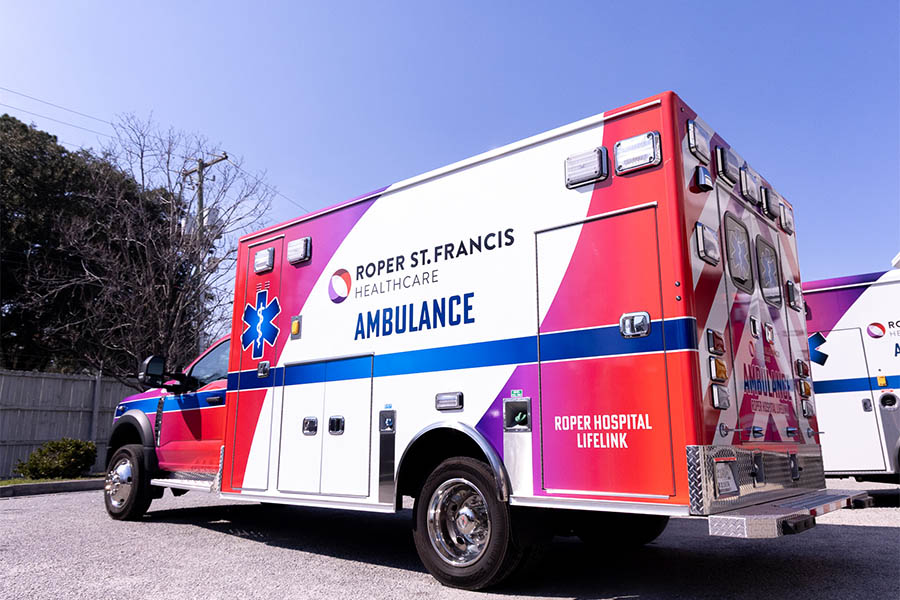
If you have seen a Roper Hospital LifeLink ambulance on the road recently, you may have noticed something different.
Two ambulances in the fleet have received a refreshed look designed with a major goal in mind: safety.
While the updated design features brighter colors and bold graphics, every element was chosen to make the ambulances more noticeable to drivers during the day and at night, which helps protect both patients and the outstanding teammates who transport them. One of the most noticeable updates is the addition of a rear chevron pattern, a reflective design commonly used to increase visibility for approaching drivers, no matter the weather conditions.
“The design might be new but the mission behind it is not,” said Matthew Ollivett, Roper Hospital LifeLink EMT. “These ambulances are designed to maximize visibility so that we can more safely serve our community.
Behind the new looks is a proud team that provides a critical link in Roper St. Francis Healthcare’s care network.


The Roper Hospital LifeLink ambulance service primarily handles hospital-to-hospital transports, moving patients between Roper St. Francis Healthcare facilities across the Lowcountry. Crews safely transfer patients to ensure they can receive the life-saving specialty services they may need, such as cardiac catheterization labs, stroke care teams and intensive care units.
These transports often involve some of the system’s sickest patients.
Inside the ambulances, crews operate equipment similar to what you would find in a hospital setting, including ventilators, cardiac monitors, medication pumps and defibrillators. Specially trained paramedics, critical care paramedics and EMTs monitor patients, administer medications and stabilize critical conditions while en route to their destination.
“Ambulances today are essentially mobile ICU rooms,” said Richard Barner, LifeLink EMS educator.
Some vehicles in the fleet are dedicated critical care units, staffed by paramedics with advanced training and national certification. These teams transport patients who may be on ventilators, receiving multiple medications or experiencing severe cardiac or neurological emergencies.
The program itself has grown rapidly in recent years.
When Kishma Rollins became the Roper Hospital LifeLink Clinical Manager in 2019, she managed a crew of five ambulances and 20 teammates. Today, the fleet has expanded to 14 ambulances and two wheelchair-accessible vans with over 60 teammates staffing them.
The service continues to evolve. Leaders are currently pursuing state certification as a “peds-ready” ambulance service, which would recognize recent efforts to equip the team with specialized training and equipment to safety transport infants and children.

The LifeLink ambulances may look different on the outside and feature more advanced technology, but the crews on the inside have the same hearts and sense of purpose they’ve had since entering the field.
“If I ever stop feeling like I’m doing something good, then I won’t come to work anymore,” Barner said. “After nearly three decades in the field, I’m still motivated to make a difference every day.”