
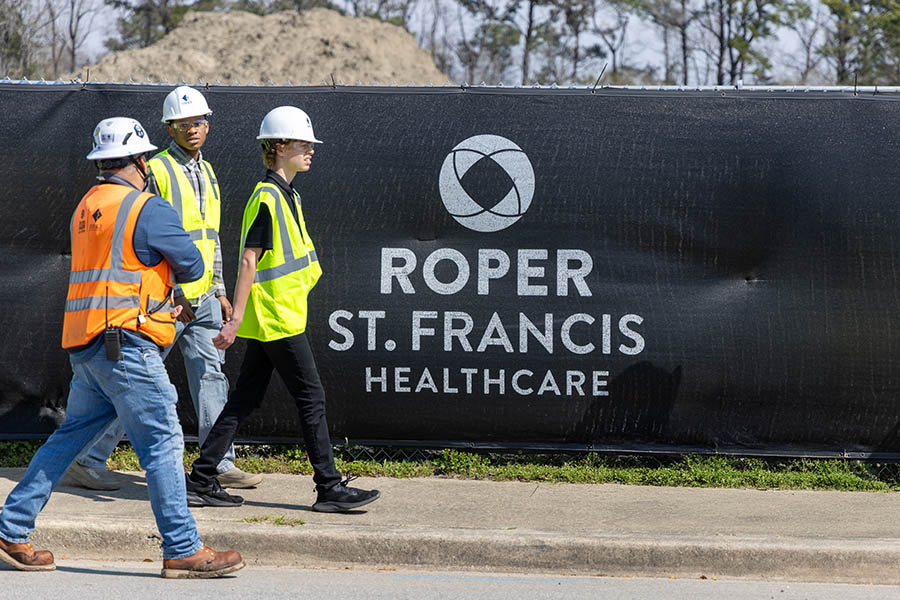
Joshua Holden, 18, stood on the future Roper Hospital construction site, watching a machine drive 47-foot concrete piles deep into the ground — the future, quite literally, taking shape beneath his feet.
For the senior at Ashley Ridge High School, it wasn’t just a field trip; it was a glimpse of what comes next. He plans to become an engineer himself one day.
“I’m amazed at the number of different people who have a hand in a project like this,” he said. “I love the fact that I can get involved in a job that can make an impact on the community.”
In early March, the Roper St. Francis Healthcare site hosted Holden, one of 60 students from Ashley Ridge, Fort Dorchester and Summerville high schools for a job shadow day at the site of the future Roper Hospital campus in North Charleston. The event was a collaboration between Dorchester School District 2 and Edifice Construction, which is building the hospital through a joint venture with Barton Malow.

They didn’t just see a job site that will change the healthcare landscape of the Lowcountry; they saw possibility.
Some arrived set on an engineering career. Others are still figuring it out. But for a few hours, all of them stood captivated by one of the largest healthcare construction projects in the Southeast — a $1.2 billion campus that will relocate more than 320 beds from Roper Hospital in downtown Charleston to a more accessible site near Interstates 26 and 526. The project is a key component of Roper St. Francis Healthcare 2030 Strategic Plan initiatives of optimizing the system’s footprint and addressing future clinical needs.
Inside a soon-to-be-demolished building, construction leaders walked students through what it takes to bring a project like this to life — years before the first patient walks through the doors.
They showed a fully interactive 4D model of the hospital, detailed down to the height of desks and the swing of a door. They explained how drones fly overhead, capturing images that are stitched together into a living map. They described how bathrooms are built off-site and lifted into place.
There are no paper blueprints; just iPads. The greatest physical representation of the project is a wall of Post-It notes that contain construction milestones from the design phase to the grand opening.
Many Barton Malow | Edifice team members who demonstrated their tools and shared details were just a few years removed from college and relatable to their audience.
“This project is only the beginning of everything that’s going to happen in this area,” said Chris Socha, Barton Malow | Edifice project lead. “The more people we can get interested in this kind of work, the better off the Charleston area will be. It’s a badge of honor to tell people we’re a part of this project, and we want these students to have that same feeling one day.”

On the site, lessons are loud, heavy and hard to ignore.
Students watched as massive concrete piles were driven deep into the ground, forming the foundation for a hospital designed to withstand hurricane-force winds, flying debris and earthquakes.
Nearby, thick concrete walls — up to 4 feet wide — are being constructed to safely contain radiation in imaging areas. A full-scale exterior mockup showed how specialized glass will resist wind, reduce noise and protect patients inside.
Even the building’s height has been shaped by its surroundings.
Because of its proximity to Charleston International Airport, engineers worked closely with federal regulators to determine how tall the structure could safely rise. The result: a roughly 10-story hospital designed not to interfere with flight paths.
Wind, too, has been studied.
Engineers built a scale model and tested it in a specialized facility, injecting smoke to watch how air moves around the structure — data that helps determine how the building will hold up in severe weather.
For Kimberly Caughell, Marketing Director for the Dorchester Two Educational Foundation, experiences like this for Career and Technical Education students are about opening doors early.
“I’m looking around and noticing the engagement and seeing the lightbulbs come on,” she said. “Some might already know what they want to do, but for others, this is where that interest really begins.”
That interest may lie in science, technology, engineering and mathematics (STEM) or biomedicine. Experiences like this can spark the minds that will design and build these facilities — or one day save lives inside them. And organizers hope this is just the start.
The goal is to bring students back during the next several years, allowing them to watch the hospital rise — from foundation and steel shell to a fully operational campus.
For construction leaders, that long view matters.
From engineers and architects to electricians and welders, the demand for skilled workers across the Lowcountry continues to rise alongside the region itself.
For Roper St. Francis Healthcare, the day reflects more than workforce development. It connects a transformational project to the community it will serve.
“This has been a long time in the making, and these professionals are a part of something big,” said Troy Powell, Roper St. Francis Healthcare’s Chief Operating Officer for Ambulatory Care, who watched his own son take part in the event with classmates. “We’re moving an entire hospital at once. That’s not something you see every day.”
On the site, students moved carefully between equipment, mounds of dirt and muddy ruts of steel tracks, asking questions about careers, college paths and how to get started.
The answers weren’t always straightforward.
Many of the professionals leading the tour said they once stood exactly where these students are now — unsure, curious and just beginning to see what might be possible.
Holden could picture it.
The hard hat. The plans. The work. As he filmed a pile driver with his cellphone, an email alert from a prospective college popped up on the screen.
One day, he hopes to be part of something like this — not just watching it rise, but helping to plan and build it.
“It’s just exciting to think about,” he said.


