
Raising a glass of wine to toast with one hand. Making the family’s favorite barbecue sauce. Putting contacts in without help.
After a spinal cord injury left her paralyzed from the neck down, those everyday tasks felt out of reach for Cindy Taylor. Even as she worked diligently through months of skilled therapy at Roper Rehabilitation Hospital first and Roper Hospital’s outpatient rehabilitation facility, Taylor still encountered limits to her independence.
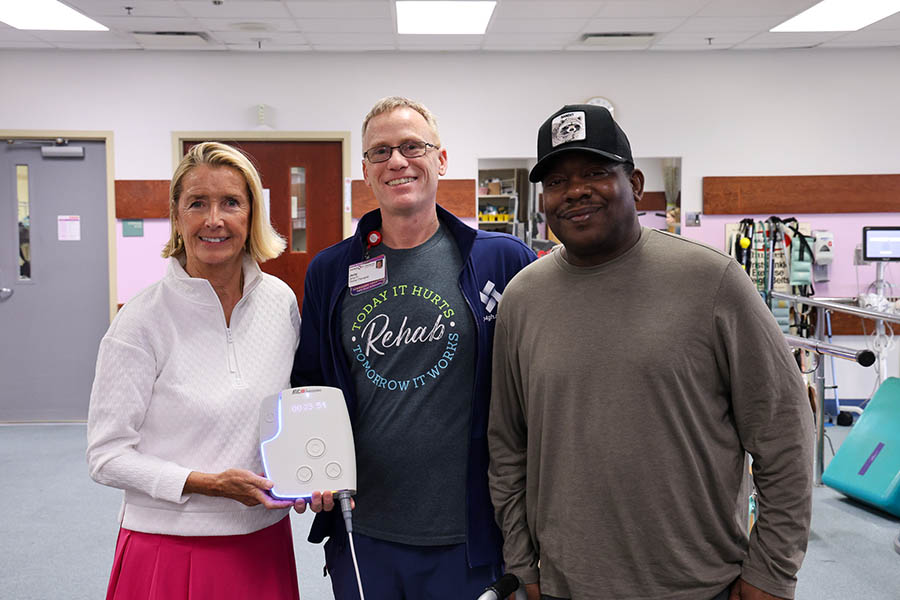
A seasoned occupational therapist with Roper St. Francis Healthcare seized an opportunity to push those limits through ONWARD Medical’s FDA-approved technology called ARCEX, which was cleared in 2024 for incomplete spinal cord injury patients in the United States. The novel, innovative and non-invasive system is designed to assist patients with spinal cord injuries regain strength and mobility in their hands and arms.
Thanks to a generous gift made through the Roper St. Francis Foundation by Taylor and her husband, David, Roper St. Francis Healthcare is the first in the Charleston area to offer this life-changing technology.
Taylor, who had already been making tremendous strides in outpatient therapy at Roper Hospital, was the first patient in the health system to use the ARCEX, and she couldn’t wait to tell others about the independence it gave her.
“It gave us hope,” Cindy said. “Hope to live everyday life to the fullest. And that’s what we’d like to give to others going through this. That four-letter word: hope.”
Building new connections
Jerry Hurst, the spirited occupational therapist who introduced Taylor to the therapy, had been following the technology long before it was FDA-approved. The results from clinical trials were promising, he said.
A preliminary study published in Nature Medicine highlighted the device’s safety and effectiveness, noting that 90 percent of participants experienced improved strength and function of their upper limbs. Hurst strongly believed his patients would benefit, too.
With 23 years of experience as an occupational therapist working with spinal cord injury and stroke patients, he keeps a close eye on evolving technology that could improve outcomes. He said that the ARCEX device is one of the most unique advances he has seen in spinal cord care in recent years.
“It isn’t about forcing movement,” he said. “It helps the brain and body reconnect.”
The technology functions by stimulating dormant neural pathways, promoting the brain to find new routes around the injury to communicate to the body.
Through repetition and guided therapy, patients begin to rebuild function.
“It’s based on neuroplasticity,” Hurst explained. “You use it, you improve it. Repetition really matters.”
It works by placing small adhesive electrodes, about the size of a sticker, along the back of the patient’s neck just over the spinal cord. Thin wires connect them to a small, portable device that delivers gentle electrical signals through the sensory nerves.
Patients describe it as a light tingling sensation, not painful.
While the device is on, they repeat functional movements, like opening and closing their hands, grasping and reaching. The stimulation and repetition work together to help the brain and body reconnect.
“It doesn’t do the work for them,” Hurst said. “They still have to think through every movement.”
For Taylor, that meant hours of focused task practice at the therapy gym and on her own at home. At first, even touching her fingers together was difficult.
Within a few months, that changed. She went from being unable to button a shirt to completing multiple buttons in a row. Her functional independence scores nearly doubled in just weeks.
More importantly, she began to reclaim her independence.
“I wanted to drive again. I wanted to cook. I wanted to do normal things,” she said. “And suddenly, I could.”
Reeling it back in
On a recent morning inside the rehab gym, another patient arrived for his session.
His name is Easy.
Just months earlier, a fall during a fishing trip changed everything. One misstep, and suddenly, the hands that once cast lines and reeled in fish with ease struggled to button a shirt or grip everyday objects.

Now, inside the therapy gym, those same hands are relearning valued daily activities. After only a few weeks using the ARCEX device, Easy is already experiencing and demonstrating progress.
“It’s more ability with my fingers,” Easy said. “Things are moving more now.”
At his sessions with Hurst, he works through dexterity exercises with small pegs, precise movements and steady focus. The kind of coordination that once came naturally to him, like threading a hook or adjusting a line, is now being rebuilt one repetition at a time.
During one recent session, he completed a dexterity test in 40 seconds — a dramatic improvement from the 166 seconds it took when he first started.
Easy’s goal is simple: to get his hands working like they used to so he can stand at the edge of a quiet shoreline again, rod in hand, feeling the pull of a line.
“I love fishing,” Easy said.
That’s what he’s working toward. And thanks to the Taylors’ generosity and Hurst’s advocacy, Easy is finding his way there, one small victory at a time.


Small wins, big change
For Hurst and the rehab team, the impact goes beyond the numbers.
“I hate when we know something could help a patient, but we don’t have the tools,” he said. “This gives us another way to help them move forward.”
Unlike larger, more cumbersome rehabilitation technologies, the ARCEX is portable, adaptable and focused on real-life function. Tying your shoelaces, holding silverware or preparing a meal are all movements that matter the most outside the clinic. ARCEX is helping patients regain the ability to do all those things and more.
It’s also still relatively new, making Roper St. Francis Healthcare one of the few places in the region offering it.
That’s exactly why Cindy and David Taylor chose to give to the Foundation.
“We’ve never made a donation just for ourselves,” Cindy Taylor said. “It’s about helping the community. And in this case, it’s about making sure more people have greater access.”
Hurst is hopeful that this technology will open new paths to independence, not only for patients with partial spinal cord injuries, but for those living with complete spinal cord injuries and the effects of stroke.
“I think this is just the beginning of something,” he said. “The more people that are able to use it, the more progress we’ll continue to see.”
That four letter word
Spinal cord injuries come with physical, emotional and psychological challenges that are hard to imagine for those who haven’t experienced it. Progress can feel slow. Plateaus are common.
That’s why, for Taylor, one word keeps coming back.
Hope.
“If there’s no downside, why not try?” she said. “Even if it helps you do just one more thing on your own. That matters.”
Inside the outpatient rehab gym, those “one more things” can add up. A button fastened, an arm lifted, a glass raised, this time with one hand.
For more information, you can reach out to the Roper Hospital Outpatient Rehabilitation Department by calling 843-724-2870 or faxing 843-720-8482.